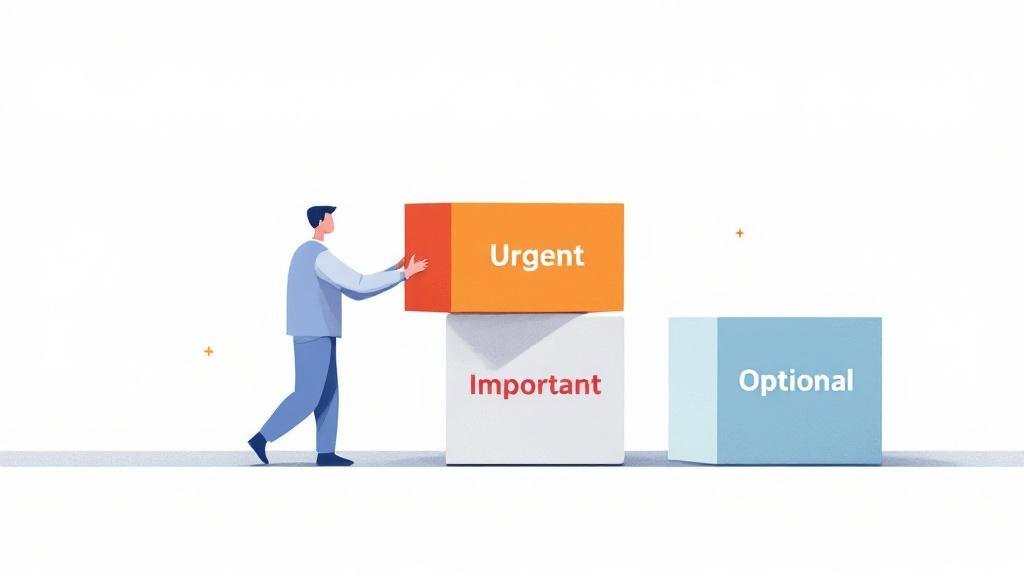
When your to-do list keeps growing and everything feels urgent, it becomes hard to know where to start. For example, you might jump between tasks or leave things unfinished. Similarly, you might also spend the day putting out small fires instead of doing meaningful work. The problem isn’t your effort. Rather, it’s the lack of clarity. When that happens, your brain switches into reactive mode. As a result, you stay busy, but not truly productive. That’s why learning how to prioritize tasks is essential when stress rises and pressure builds.
The solution isn’t to work faster. Instead, it’s to build a simple structure that shows what truly deserves your focus right now. Once you learn how to filter tasks through clear criteria, prioritizing becomes easier and far less stressful.
Below is a practical system you can rely on anytime your workload feels overwhelming. It’s a simple, repeatable guide that shows you how to prioritize tasks without second-guessing yourself.
1. Start With a Quick Task Audit (The 5-Minute Reset)
Before you set priorities, take a moment to see everything clearly. Many people try to prioritize while it’s all still mixed up in their head — and that creates a false sense of urgency.
Use this simple 5-minute audit:
Step 1: Write down everything that needs to be done.
For instance, list work tasks, errands, messages, deadlines, and follow-ups — list them all without filtering.
Step 2: Label each task with one of three categories:
- M – Must do (non-negotiable, time-sensitive, impacts others)
- S – Should do (important, but timing is flexible)
- C – Could do (useful, but optional or low impact)
Step 3: Circle the tasks with external deadlines.
These usually matter more than internal ones.
This quick audit clears mental clutter and makes the next step much easier. Consequently, it becomes far easier to determine your real priorities.
2. Use the “Urgency Filter” Instead of Relying on Emotion
When everything feels urgent, you need a neutral filter. Therefore, it helps remove emotion from decision-making.
Ask yourself three questions:
- Does this have a real deadline or just pressure?
- What happens if I don’t do it today?
- Who is waiting on this task?
In many cases, this reveals tasks that only feel urgent because they cause stress — not because they actually demand immediate action. In fact, emotional urgency often disguises itself as real urgency.
For example:
- Responding to a message from a colleague?
→ Emotional urgency, not real urgency. - Submitting a report needed for a meeting in two hours?
→ Actual urgency.
Once tasks pass through this filter, they separate themselves. Consequently, clarity improves and prioritizing becomes easier. This clarity helps you prioritize based on real urgency, not stress. This step alone makes it much clearer how to prioritize tasks without letting stress decide for you.
3. Apply the 1–2–3 Priority Method
When your list feels full of urgent items, you need a simple method to think clearly. That’s why the 1–2–3 Priority Method works so well.
To begin with, use the 1–2–3 Priority Method
• 1 “Critical” Task
This is the one task that moves the day forward — the work you’d choose if you could only finish one thing.
Characteristics:
- External deadline OR high-impact outcome
- Directly affects other people or projects
- Cannot be postponed without consequences
• 2 “Important” Tasks
These are tasks that support progress but aren’t mission-critical today.
Characteristics:
- High value but not time-sensitive
- Contribute to long-term goals
- Keep projects moving steadily
• 3 “Supporting” Tasks
Similarly, these can include small tasks, admin, communication, or low-effort items.
Characteristics:
- Quick wins
- Maintenance work
- Can be moved to tomorrow without major issues
This gives you structure without stress. Moreover, it helps you see what matters first — quickly and clearly. As a result, even chaotic days feel far more manageable.
4. Use Time Windows to Handle Urgency Without Burning Out
You don’t need to choose between urgent and important work.Using the right time windows helps you stay focused without burning out. Instead, set time blocks that give each group its own space in your day. By doing so, you reduce decision fatigue dramatically.
This approach also makes it easier to see how to prioritize tasks throughout the day without feeling torn between different responsibilities.
Here’s a recommended structure:
Morning (High Focus): 09:00–11:00
Critical task block
To stay focused, work on the one high-impact task before touching messages or admin.
Midday (Moderate Energy): 11:00–13:00
Important task block
During this time, focus on two important tasks that support bigger goals.
Afternoon (Lower Focus): 14:00–16:00
Urgent admin + communication block
Emails, responses, small tasks, approvals, updates.
Late Afternoon (Reset): 16:00–16:30
Then, review and plan tomorrow by identifying the next day’s Critical/Important/Supporting tasks.
As a result, this setup prevents the classic cycle of spending your morning reacting to messages and never getting to important work.
5. If Everything Truly Is Urgent, Use the “Impact vs. Consequence” Test
Sometimes all tasks really are time-sensitive — especially in fast-paced environments. In that case, use this quick filter:
When that happens, and everything has a deadline, use this quick filter:
Impact Question:
Which task moves the project, team, or outcome forward the most?
Consequence Question:
What suffers if this task doesn’t get done today?
Then prioritize using this order:
- High consequence + high impact
(These are your real top priorities.) - High consequence + low impact
(Admin tasks others depend on.) - Low consequence + high impact
(Long-term growth tasks — do these after urgent work.) - Low consequence + low impact
(These can be moved.)
This instantly clears the fog when your whole list feels like a crisis.
6. Tools and Templates That Make Prioritizing Easier
Digital Tools
- Todoist – use simple priority tags (P1, P2, P3)
- TickTick – timeline view with focus mode
- Notion – build your own priority dashboard
- Motion – auto-schedules tasks by urgency
- Sunsama – daily planner with only 3–5 key tasks
In addition to digital tools, printables that work well include:
- Daily Priority Planner
- 1 Critical
- 2 Important
- 3 Supporting
- Urgency Filter Sheet
- Deadline / Impact / Who’s Waiting?
- Impact vs. Consequence Matrix
- Task Parking Lot
- To capture distractions without switching tasks
Overall, these tools help maintain structure. They also prevent multitasking and support focused work.
7. Sample Daily Schedule for a High-Urgency Workday
If your day often feels like a rush of deadlines and messages, here’s how a structured schedule can help you breathe again while staying on track.
08:45–09:00
Quick task audit + choose today’s 1–2–3 priorities
09:00–10:30
Critical task: Finish proposal draft
10:30–10:40
Short review + reset
10:40–11:20
Important task: Prepare slides for tomorrow’s meeting
11:20–12:00
Important task: Review two client documents
13:00–14:00
Urgent email replies + requests that impact others
14:00–15:00
Supporting tasks: Admin updates + approvals
15:00–16:00
If needed, use this time as a catch-up window for unexpected tasks.
16:00–16:30
Plan tomorrow using the 1–2–3 method
This schedule balances urgency with energy levels. Furthermore, it ensures you’re never guessing where to focus next.
Summary
Understanding how to prioritize tasks in different pressure levels helps ensure that your workflow stays balanced, even on your busiest days.
When everything feels urgent, structure reduces stress. Knowing how to prioritize gives you control again. By listing tasks, using clear filters, and choosing priorities, you move from reacting to planning. This leads to calmer days, clearer decisions, and steady progress — even when your workload is heavy.
In fact, you don’t need to do everything today. Instead, you just need to do the right things today.
Try This Today (Quick Challenge)
To start, take five minutes to write down everything on your mind. Then pick:
- 1 Critical task
- 2 Important tasks
- 3 Supporting tasks
Do them in that order — and notice how much calmer your day feels.
🚀 Work Smart, Live Fully
Productivity isn’t about doing more — it’s about doing what matters most.
Explore more from KnowlyDaily :
- Self-Growth & Mindset – Build a mindset that supports progress.
- Healthy Lifestyle Tips – Fuel your focus with better habits.
- Smart Money – Organize your finances with clarity and control.
- Learning & Skills – Learn faster, deeper, and smarter.
- Travel & Global Life – Take your work-life balance on the road.
Our Partners
Sometimes, the best reminder to stay calm and confident is something you wear every day.
💡 Explore EveryMoodTee — minimalist T-shirts that speak your mood before you say a word.