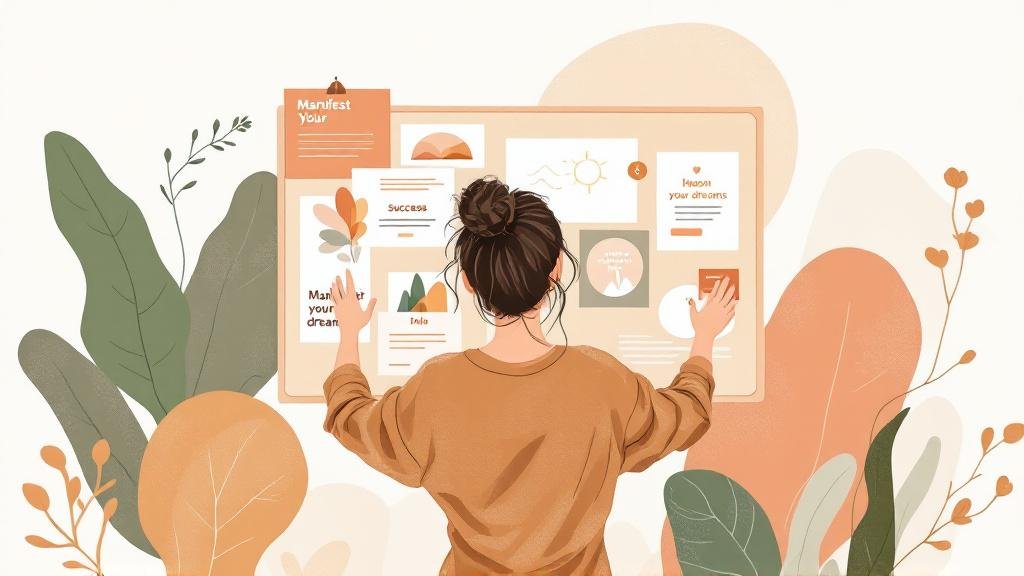
Have you ever created a vision board filled with beautiful images, only to forget about it weeks later? At first, it feels exciting; however, that feeling often fades faster than expected. In that moment, you cut out photos, imagine your dream life, and feel hopeful. Then daily routines return, motivation fades, and the board quietly blends into the background.
If that sounds familiar, you’re not doing anything wrong. In reality, most people don’t struggle because vision boards ‘don’t work. They struggle because they skip the part that makes a vision board meaningful: emotional connection.
A vision board isn’t decoration. Rather, it’s a conversation with your future self. And when you create it with clarity, honesty, and intention, it becomes a powerful tool for direction, not just inspiration.
I learned this the hard way; in fact, it took years to understand. Years ago, I made a vision board full of things I thought I should want. Success. Productivity. Busy energy. It looked impressive. Yet every time I glanced at it, I felt nothing. No pull. No excitement. No sense of belonging.
Everything changed when I rebuilt my vision board from a different place — not ambition, but alignment; from that point on, it finally felt real.
If you want to know how to create a vision board that works, start here.
Start with how you want your life to feel
Before images, before scissors, before digital tools, pause.
Ask yourself one gentle question:
“How do I want my life to feel?”
Not what you want to own.
Not what you want to achieve.
Not what looks impressive to others.
Instead, focus on feelings.
Do you want calm?
Confidence?
Freedom?
Connection?
Stability?
Joy?
When you build your vision board around feelings, every image becomes emotionally anchored. As a result, your brain connects your goals to meaning, not pressure. That connection is what makes a vision board effective.
Reflect on where you are right now
A vision board works best when it grows from honesty.
Take a few minutes to reflect:
- What feels misaligned in my life right now?
- Where do I feel stuck or drained?
- What areas need more care or clarity?
This step doesn’t require judgment; rather, it creates awareness. Instead, it creates awareness. And awareness gives direction to your vision.
When your board responds to your current reality, it feels relevant. Therefore, you’re more likely to engage with it consistently.
Choose intentions before images
Many people rush straight to visuals. However, intention should come first.
Write down 5–7 clear intentions such as:
- I choose peace over pressure.
- I create work that supports my well-being.
- I trust myself to grow at my own pace.
- I build relationships that feel safe and mutual.
These intentions become filters. Every image you choose should support one of them. If an image looks nice but doesn’t match an intention, let it go.
This step transforms your vision board from random inspiration into focused direction.
Select images that spark emotion, not comparison
When you gather images, pay attention to your body.
Notice what feels expansive.
Notice what feels heavy.
Notice what creates quiet excitement.
Avoid images that trigger comparison or urgency. Instead, choose visuals that feel possible and nourishing. A vision board should invite you forward, not make you feel behind.
Emotion matters more than aesthetics. When an image creates a feeling of recognition — this feels like me — you’ve chosen well.
Add words that guide your mindset
Images speak to your imagination. Words speak to your focus.
Include short phrases or affirmations such as:
- “Slow progress is still progress.”
- “I am allowed to grow gently.”
- “Clarity comes from action.”
- “I trust the timing of my life.”
These words help anchor your vision during difficult days. When motivation dips, language brings you back to intention.
Keep the wording simple. Let it feel like encouragement, not pressure.
Organize your vision board by life areas
Structure helps your mind process information more clearly.
Consider grouping your vision board into areas such as:
- Well-being
- Career or purpose
- Relationships
- Personal growth
- Rest and joy
This layout allows you to see balance — or imbalance — at a glance. It also reminds you that success isn’t one-dimensional. A vision board that works supports your whole life, not just productivity.
Place your vision board where you’ll actually see it
A vision board can’t support you if it stays hidden.
Place it somewhere visible but gentle:
- Near your workspace
- Beside your bed
- As your phone or desktop background
- Inside a journal you open daily
Visibility matters. However, pressure doesn’t. The goal isn’t constant staring. The goal is consistent reminder.
Even a brief glance reinforces intention.
Interact with your vision board regularly
This is where most vision boards lose power.
Instead of only looking at it, interact with it:
- Read one phrase out loud in the morning
- Choose one image and ask what step supports it today
- Reflect weekly on what feels closer
- Update images as you grow
A vision board works when it evolves with you. Growth changes priorities. Let your board reflect that change.
Take aligned action, even when it’s small
A vision board isn’t magic. It’s guidance.
Each image represents direction. Action turns direction into reality.
Ask yourself daily:
“What is one small step that aligns with this vision?”
Small steps build momentum. Momentum builds trust. And trust keeps you engaged with your vision even when progress feels slow.
Release attachment to perfect outcomes
Sometimes a vision shifts. That’s not failure. That’s growth.
A vision board should feel supportive, not restrictive. If something no longer resonates, adjust it. If a goal changes, honor that change.
Flexibility keeps your vision alive.
A vision board works when it feels like home
The most powerful vision boards don’t shout. They whisper.
They remind you who you are becoming.
They ground you during uncertainty.
They reflect your values, not expectations.
When you create a vision board with intention, honesty, and emotional connection, it becomes more than a collage. It becomes a relationship with your future self — one built on trust, patience, and belief.
You don’t need a perfect board.
You don’t need perfect clarity.
You only need willingness.
And from that willingness, your vision begins to work.
🌱 Turn Growth into Lifestyle
Growth doesn’t stop at the mind — it flows into how you live, learn, and make choices every day.
Explore more from KnowlyDaily:
- Healthy Lifestyle Tips – Strengthen body and balance energy.
- Productivity – Stay focused, organized, and calm under pressure.
- Smart Money – Practice mindful spending and confident saving.
- Learning & Skills – Keep your growth structured and sustainable.
- Travel & Global Life – Find perspective and joy through travel.
Our Partners
Sometimes, the best reminder to stay calm and confident is something you wear every day.
💡 Explore EveryMoodTee — minimalist T-shirts that speak your mood before you say a word.